Thursday, May 27, 2010

Père Lachaise Cemetery (19)

Okay, my heart starts beating a little faster now that I get to write about Père Lachaise! Don't think I'm morbid or anything, but my visits (yes, two and soon to be three) to this famous cemetery may have been made during a five day stretch during which I also visited the Saint-Denys Basilica where all the French royalty is entombed and the Parisian catacombs.

Yeah, it's a little creepy and morbid, and I'm trying to come to terms with the fact that I enjoyed it so much. There's something necromantic in me that's trying to come to light (ha! Light, death, ha!).

First, this cemetery is really beautiful. There are such charming tombs that it would be a shame not to show you at least a few. Some, I think, look more like little churches than graves. Further, the cemetery is a veritable little city within a city! The walks book calls the cemetery the "Parisian Necropolis," quite a fitting name.


As a fan of the "fantastic"--that is to say, I want to read ghost stories for a living (keep your fingers crossed for me that it works out)--I was most charmed by the tombs that look like they've been broken into... or out of!

Really creepy, huh?

Buried in Père Lachaise cemetery are all kinds of famous people like Chopin, Molière, Jim Morrison, the painter Georges Seurat, and of course Oscar Wilde, whose grave people kiss, either out of "appreciation" or as the "ladies' revenge" for his apparently sometimes misogynistic writings.

I am most excited about the cemetery because it figures prominently in two of my favorite works.

The first is a vignette from the film Paris, je t'aime, a French-American collaboration film that tells a love story for 18 of the 20 "arrondissements" (major neighborhoods) of Paris. This is one of my favorites from the film, and takes place in Père Lachaise! Check it out.

The second is the story I finished approximately four hours ago, called "The Room in the Dragon Volant" by Sheridan Le Fanu, an excellent tale I think everyone should read.

But that's just morbid me.

Seizième Arondissement Walk (13)

Yesterday I took this walk with-my-by-myself (if you don't get the allusion, go watch SNL's parody of the Lawrence Welk Show on Hulu), which was a nice opportunity to sort my thoughts and wander a bit. The 16th district in Paris is a hilly neighborhood and quite a snobbish one at that.

As a passive fan of Art Nouveau, the architectural highlights of this trip were the buildings designed by Hector Guimard, like Castel Béranger:

Oh! I love that font! See it up in the left hand corner? Yep, that's his signature.

Next I wandered up past the home of the famous Realist/Fantastic/Romantic author, Balzac (who's photo is so epic it's worth including).


But this was all a build up to my favorite part of the walk, Musée Marmottan, which houses many of Monet's most famous works, including Soleil-levant:

That piercing orange is so striking! I like, I like, I like. As I wandered through the Monets listening to Dvorák's New World Symphony, I actually discovered that while his waterlilies are nice, my favorite paintings of his are not the blue-green-purple tones, but rather his paintings in yellows, oranges, reds, and pinks. Perhaps it was my humor, or perhaps it was the rain outside, but the cool hues left me unsatisfied, while the vibrant yellows brightened my soul! (Sorry, Paris is contagiously poetic)

The other most excellent thing I saw at Musée Marmottan was one of Monet's paint pallets. So cool! It looked itself like one of Monet's paintings. It also struck me that often, Monet leaves some canvas visible--he won't paint all the way to the frame, or leaves naked patches between brush strokes, although they're barely visible.

Overall, this museum is very much worth the visit.

As I left the Museum, the sky opened up and I was caught in a torrential downpour, which, though short, left me very wet. I headed to Judy's and watched a movie while waiting for my clothes to dry. Have you seen 500 Days of Summer? I very much enjoyed it.

Sainte-Sulpice (12)

This walk took us to the (in)famous church of Sainte-Sulpice. Remember, Dan Brown's Da Vinci Code? It turns out, that's all a hoax.

Anyone surprised? The best part is the church's attitude towards the hullabaloo that attracts so many tourists. Dr. Olivier, who wrote up the guide for this walk, explains that the articles on the wall essentially say: "Go ahead and take a picture of the gnomon like all the other tourists, but please, don't go knocking around for hollow tiles including clues to the Holy Grail. (It's hidden under the Louvre pyramid anyway, remember?)" It's worth including a picture, though.

The church was actually designed by Jean-Nicolas Servadoni, during the day an architect, but by night created elaborate theatrical productions. Quite a spectacle--both the theater (or so I hear) and the church.

Very entertaining commentary. Again, I felt about this walk the same way I felt about the Marais 2 walk--not a lot to say specifically about the sights we saw. What I enjoyed about the area around Sainte-Sulpice was the feel of the neighborhood. In the immediate vicinity are specialty shops in two of my favorite things (and would one of my blog posts be complete without some kind of list? I think not):

(1) Chocolate, at the shop of Pierre Hermé. His macarons are reputedly delicious and come in such bizarre combinations of flavors (litchi-rose-raspberry is at the top of my list of macarons to try!). I think that's my goal for tomorrow.
(2) Books, at the anglophone book store The Village Voice.

Nice quarter, nice vibe. But not a lot to report in the way of spectaculars.

Lutetia Pulchra Est: the Paris of Antiquity and the Middle Ages (11)

Beth, Judy, and I took this walk on Friday the 21st of May. It was quite a sizable walk!

First, we tackled the Cluny Museum, the National Museum of the Middle Ages, which was actually remarkably interesting. If I hadn't, however, had French 361 with Dr. Hurlbut, in which we studied French history from the beginnings up to 1715, I would have probably been bored and lost. Isn't it incredible how a teacher who's passionate for their subject can inspire in his or her students a spark for things as obscure as capitals in medieval cathedrals? I aspire to that.

One of the coolest things we saw at the Cluny was the heads of the statues of the Biblical kings that were thwacked off during the French Revolution. The rowdy revolutionaries mistook the statues of the kings on the facade of Notre-Dame for the kings of France and thus beheaded them in a fit of anti-monarchal furor. The heads were thought to be lost but were found buried in a courtyard in 1977, nearly two centuries after the vandalism. Now, they're at the Cluny! Check it out:


The other really exciting thing we saw at the Cluny was the famous tapestries of the Lady and the Unicorn. Judy got some great pictures, which I have permanently borrowed:

There are, of course, all kinds of theories about what the tapestries actually represent. A few bits of trivia associated with the tapestry:
(1) In the Middle Ages, the unicorn was associated with virgin purity, as the fabled beast was believed only to approach chaste young women.
(2) There are six tapestries, five of which depict the five sense of sight, hearing, taste, touch, and smell. In the sixth tapestry, the lady removes the necklace she wears in the first five, apparently dedicating herself "à mon seul désir" (to my only desire) in a vow to transcend the pleasures of the senses. That "seul désir" could be romantic or religious--a chivalrous knight or to Christ.
(3) These tapestries were discovered by Prosper Mérimée, a 19th century writer, historian, and archeologist, who authored several fantastic tales, which genre has captured my heart over the last year, including La Vénus d'Ille, which you should probably read.

The next highlight of the walk was the Sorbonne, the prestigious French university founded during the Middle Ages. Since the student riots of 2007, the Sorbonne is no longer open to the public. Oh, how I dream of entering such a prestigious place!

From the Sorbonne, we walked to the Pantheon where the French bury their "gods" of philosophy, science, politics, literature, etc. Just a taste of whose remains reside there: Victor Hugo, Pierre and Marie Curie, Voltaire... The building was originally intended to be a Catholic church, but it was unfinished at the time of the (very anti-clerical) Revolution, and was thus converted into a repository for the great men and women of France.

Oh, also, there are some really cool pillars outside the Pantheon that are great for climbing:


Just past the pantheon there's a really beautiful church, Saint-Etienne-du-Mont. I've never seen such graceful stone. Here's a picture just for your viewing pleasure:


The last stop on this walk was the so-called Arènes de Lutèce, the Roman arenas that date from when Paris was still called by its Roman name: Lutèce or Lutetia. We decided to stage some gladiator battles:

Le Marais: Part II (8)

Since Beth and I were feeling ambitious, we did both the Marias Part I and Part II walks à la suite--that is, one after the other. The second part of the walk took us through the Pletzel, the Yiddish name for the Jewish quarter. My favorite part of this walk would have been the Musée Picasso... if only it weren't closed until the 23rd of August for renovation. Pooh, pooh. Oh well! I guess that means I just have to come back.

The other museum on this walk the Musé Cognacq-Jay, which houses a lot of paintings, furniture, and objets d'art from the 18th century. We chose the right moment to do this walk, because in class, we had just finished discussing Baroque art. Seeing works by François Boucher, Frangonard, Greuze, de Latour, and Rubens reinforced what we had just studied. I think 18th century art is terribly romantic (obviously not Romantic, let's not mix our centuries!), and although I can only tolerate about an hour and a half of it at a time, that was about how long it took us to go through the museum. The French portraits from the period are charming, and reminded me of my favorite English portraitist, Thomas Gainsborough. See any resemblance?
[Quentin de la Tour, La Marquise de Pompadour, the rather famous mistress of Louis XV]
[Thomas Gainsborough, Mrs. Hibbert]

Obviously, they're stylistically a bit different. That stylized French face, neck, and hair... But de la Tour and Gainsborough were the most celebrated portraitists of the 18th century France and England respectively.

As for the rest of our tour around the Marais, there isn't much to say or see or describe. Yet I enjoy the quarter for its cool vibe!

Le Marais (7)

I think the Marais is one of my favorite districts in Paris. It's got lots of cool things in it, including, but not limited to:

(1) The LDS Institute building
(2) Le Gay Choc (even if I can't eat the bread, I can still appreciate)
(3) Victor Hugo's house, which is part of
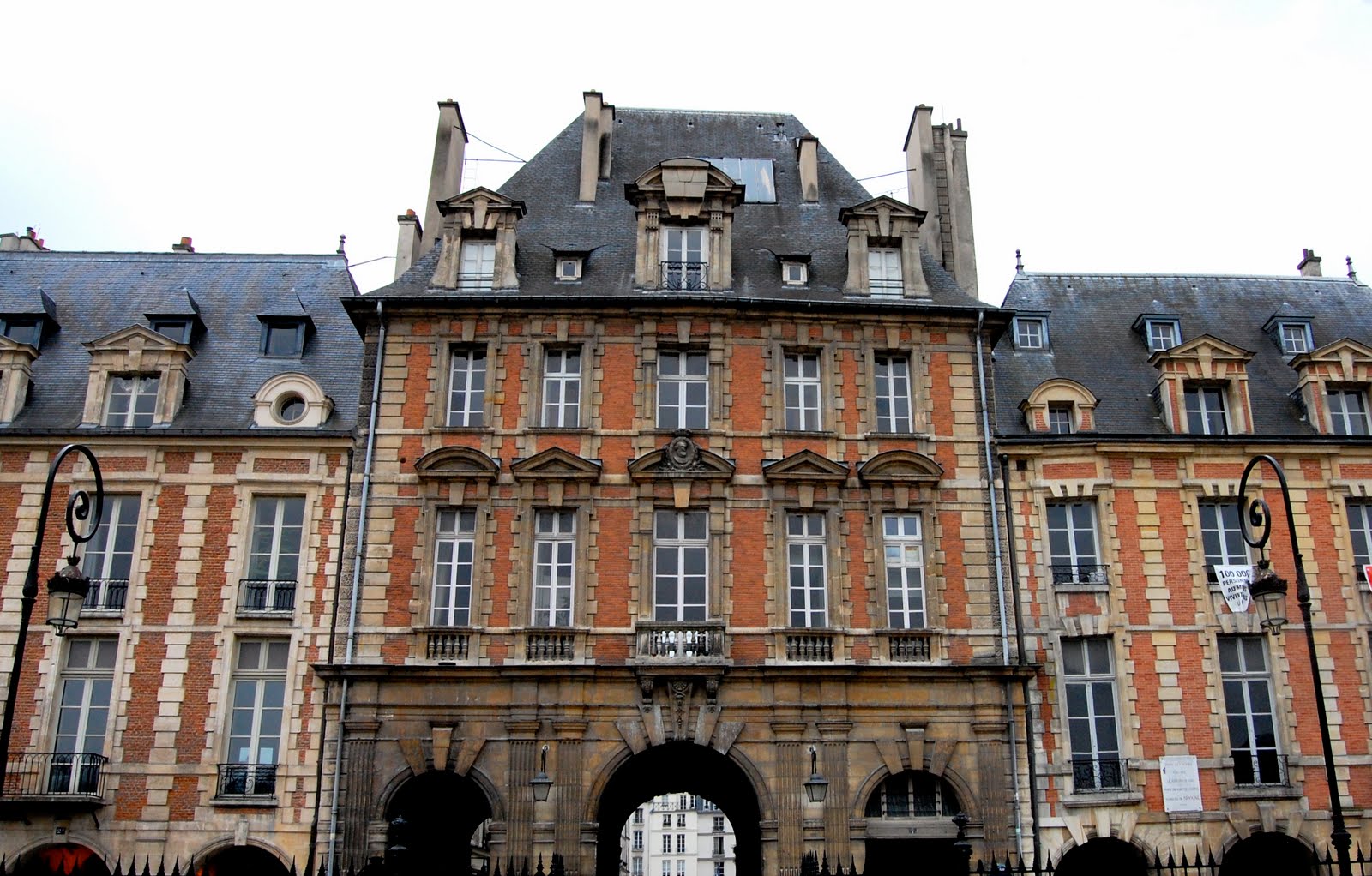
(4) Place des Vosges, the site of a very exciting Sunday afternoon picnic
(5) an American Apparel
(6) Hôtel de Ville, the most convenient meeting place and also the location of a very convenient post office, which means an ATM with no foreign fees
(7) the Jewish Quarter, which means good falafel
(8) Saint Paul's cathedral
(9) A genuinely cool vibe. I like.

On the 15th of May, Ryan, Judy, Beth, and I went on the prescribed Marais 1 walk and saw some cool things, including:


In this picture, you can see some of the old city wall. Cool!

Now onto the Place des Vosges!


The smiling King Henri IV created this courtyard and surrounding apartments as part of his beautification of Paris. Lots of famous people lived here in the following centuries, including Cardinal Richelieu, the loquacious letter-writer Madame de Seevigné, and Victor Hugo, who's apartments are now a museum! As I mentioned in my handy-dandy list above, it was also the site of of a tranquil Sunday afternoon picnic, since it's only about a 7 minute walk from the LDS Church building.

On our walk, since Judy is crazy-in-love with Victor Hugo, we stopped at his house, now a museum. Much cooler than I had anticipated! There was a temporary exhibit on the romantic movement of Orientalism. Hugo himself wrote a collection of poems called Les Orientales, which I've studied a few times in my BYU French career. The exhibit incorporated some beautiful Romantic paintings by artists like Delacroix with extracts from Hugo's Oriental poems. It's always a relief to find out the things you study in school actually exist in the real world.

Of Art, War, and World's Fairs: Invalides, Musée Rodin, and the Eiffel Tower (3)

Sorry for not posting in awhile! Today there's going to be quite the flood of updates... Seems to be that being in Paris has led to some serious procrastination of homework. Whoops!

On Tuesday, Judy, Beth, and I went on a walk that took us to some of the most memorable spots in Paris.


We began by this bridge, the Pont Alexandre III, named for the Russian Czar, which was built in 1900 as a symbol of the friendship between France and Russia. The year 2010, as my friend Mathilde, a French student of Russian, informed me, is designated as a celebration of Russian and French relations. We've seen a few evidences of this celebration, including the exhibit Sainte Russie at the Louvre, which was really quite interesting! I know very little about Eastern Orthodoxy and its art, but my vague background in Catholic art and architecture made for some interesting comparisons.


The next highlight of the tour was Napoleon's tomb in the Dôme church at Invalides. The complex of the Invalides (yes, that's "the invalids"), was built to house soldiers wounded in Louis XIV's (many) military campaigns. Today, Invalides is an interesting fusion of tourist site (home to the French Army Museum) and veteran's hospital--it's still retained some of it's original function! Curiously enough, the Church of the Dôme is the only church we've had to pay to enter. Napoleon's entombed remains were admittedly impressive, mostly for the size of the room:

Anybody else think he was making up for something? (Wink.)

Then came my favorite part of this walk: the Rodin Museum! I had visited the gardens last year, which are very cool, but I think my favorite part of the museum was actually Hôtel Biron, once Rodin's own home, which now houses some of his own works as well as his private collection. My dear Aunt Jean had told me to keep an eye out for this particular painting:

This is Père Tanguy, who used to mix the paints for artists like Van Gogh himself. Jean, I'm working on getting a hold of a print or a postcard of the painting! I wasn't able to find one in my brief time in the Museum gift shop, but I will go back on a more thorough hunt.

From the Musée Rodin, my friends and I headed to the Champ de Mars, the park in front of the Eiffel Tower, to picnic and nap, one more evidence for the best skill I've acquired since I've arrived in Paris: flâner, meaning to loaf around, to loiter, to take time to enjoy little joys! It was an excellent afternoon.